
I love the idea of living completely off-grid, self sufficient in harnessing your own energy needs, food supply and generally keeping things simple and getting back to nature. It’s partly why I started a bespoke garden room business, as I want more people to experience the connection with the outdoor, especially in these challenging times when we are all spending more time at home.
I recently cam across this article on Tree Hugger, by Lloyd Alter who teaches sustainable design at Royston University in Toronto. And I would love to share it with you as I think there is a lot to like about this little eco-pod. A re-purposed shipping container providing a living space with all that is required to live a comfortable existence but with a greater connection to the outdoors. I think this obviously works better in dryer, sunnier conditions and might be a little too extreme for a British garden , but there are a lot of interesting deign choices that we can take inspiration from.
So here we go, enjoy….
We have often asked “does shipping container architecture make sense?” and the answer is often “no.” These are boxes designed for shipping freight, not housing people. But the off-grid container house, Gaia, designed by Joshua Woodsman of Pin-Up Houses makes a lot of sense.

It knows what it wants to be: a comfortable, self-sufficient cabin-in-the-woods type of place with carefully considered systems and a really well-resolved interior. The first thing that grabbed my attention was the galvanized corrugated steel hat that keeps the heat of the sun off the box, and provides extra area for rainwater collecting. The solar panels and wind turbine charge two batteries, which will generate enough power for lights and water pumps.

The hi-cube (9′-6″) 20-foot container is insulated with spray foam (not a Treehugger-correct product but you don’t have much choice when you are fighting for inches) and lined with plywood.

The problem with spray foam is that it is highly combustible, a solid fossil fuel. However, the woodstove is properly shielded with steel on the floor and behind, and there are lots of exits.

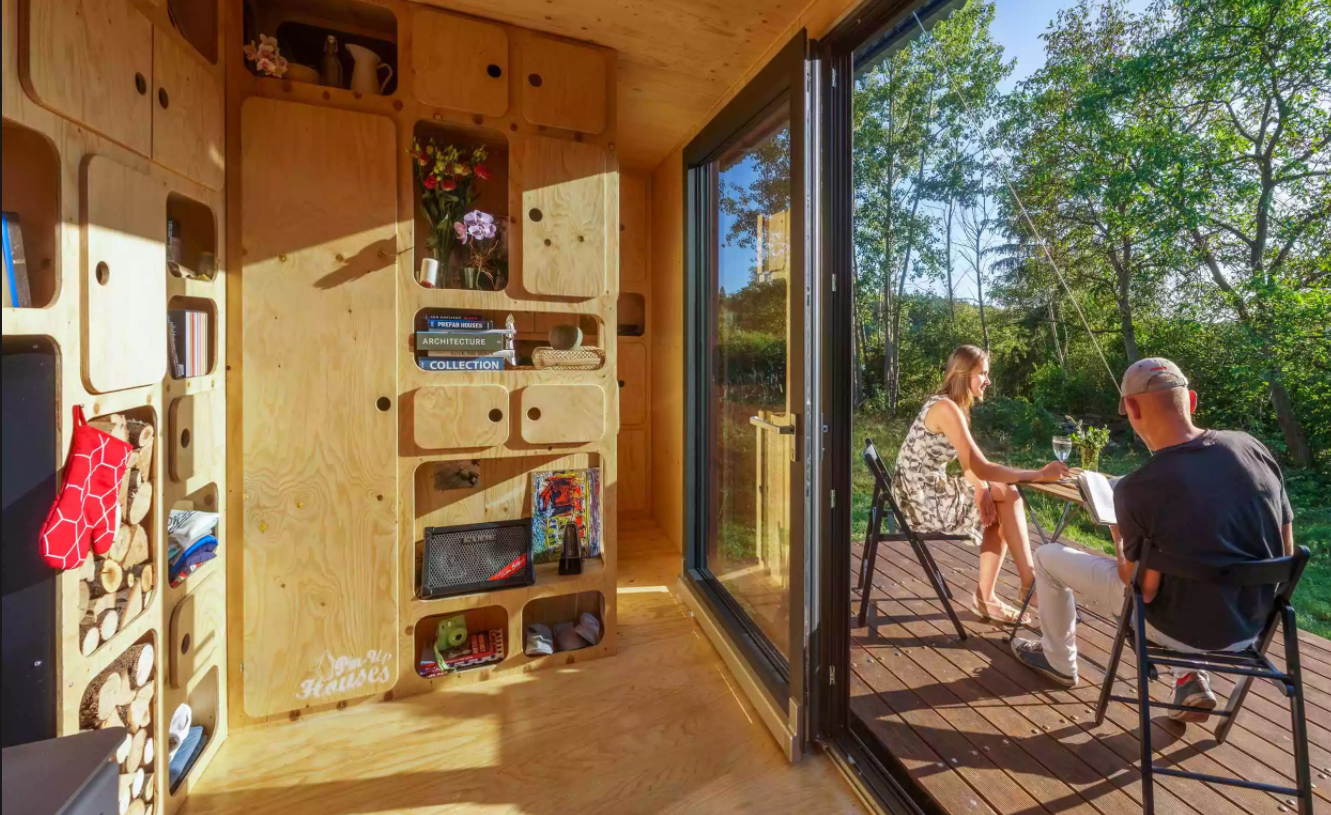
Another feature I admire is that the designer is not afraid to give up space for a decent bathroom and kitchen, and all this wonderful storage shelving cut out of sheets of plywood so efficiently. The shelving appears to be a trademark feature of Pin-Up Houses, as can be seen in the France Prefab and the Magenta Tiny House.

The folding bed is also a feature seen in other Pin-Up Houses. It is a very simple and affordable design that transforms from a bed to a sofa or can fold up completely and disappear into the storage wall. It’s not a fancy counterbalanced design but relies on pulleys and ropes, a much more economical system. Woodsman is building prototypes and selling plans, so he is making design decisions based on people with tight budgets being able to do all of this themselves.

Most designers working with shipping containers and tiny houses slam the bathroom across the end of the unit and have the kitchen open and visible. I have never seen it done this way, with the kitchen tucked in beside the bathroom, with a marine style stove and sink, tiny fridge, and so much storage! No wonder she is smiling.

The bathroom is generous too, although a room full of water would not be my choice for locating the batteries, inverters, and electrical systems. Also shown here is a Porta-Potti chemical toilet, where the bottom half is a suitcase full of waste and formaldehyde chemical that has to be taken somewhere and dumped, not a green and sustainable solution. However, this is a prototype, and there is plenty of room there for a small composting toilet.

There is a lot to love here; there is enough room to have a nice breakfast on your folding tables and chairs.

When you are done, you fold them up and hang them on the wall. Again, such a simple and affordable solution.

This is when shipping containers make sense, because they are designed to be secure. With this building, you just close up the doors on the end, grab your suitcase of poop, and then pull up and lock the drawbridge/deck/door – people would have to work really hard to get inside. They may take your turbine and solar panel, but everything inside is pretty secure. Last word to Joshua Woodsman:
“Sustainable living has never been so easy, nor has it been as necessary as it is now with environmental problems such as global warming and a drastic increase in waste materials. The Pin-Up House Gaia is here to allow you to live in harmony with nature using green energy with style and comfort.”
Leave a Reply