
Let’s face it we are all spending a lot more time at home these days. For some of us this means working, teaching kids along with all the normal day to day activities. Our houses are literally bursting at the seams. Think you are alone, think again. This is happening globally, but in this country we are lucky that a very high percentage of our homes have a outdoor space.
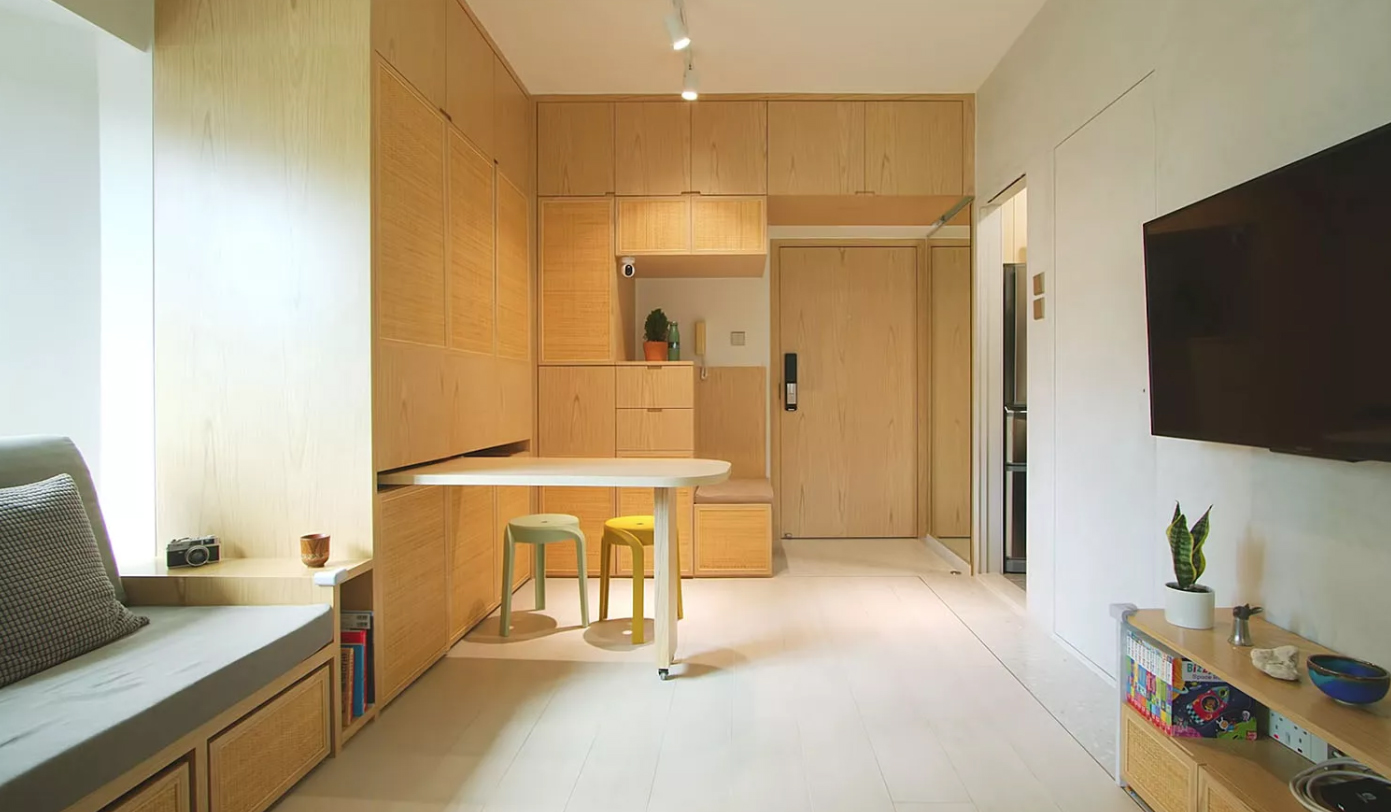
This apartment in Hong Kong is smaller than some people living rooms, yet the architects have created an extremely functional space, which can be used for a variety of uses. They have kept the palette of materials and colours to a minimal to increase the sense of having more space. They have also used very clever storage ideas, fold out dining tables and office furniture to ensure the maximum use is extracted out of this very small space.
I think you will agree this is a very inspiring project, that appeared this week on the Treehugger website. So lets find out more in this piece written by kimberley Mok for the website.
With some of the most expensive real estate prices in the world, much of the populace of the tiny island metropolis of Hong Kong is familiar with living in small spaces – sometimes with one’s extended family. With a population of more than 7 million people dwelling on 426 square miles of land, Hong Kong is a densely packed city where there’s nowhere to go but up, making the soaring versatility of its residential towers a common sight.
But as we’ve seen time and time again, even in the hyper-density of Hong Kong, thoughtful design can transform cramped, compact spaces into something else altogether. For instance, in this renovation of a 430-square-foot (40 square meters) apartment for a family of three, local architecture firm Absence From Island was able to convert the aging apartment – dating back to the 1990s – into a bright, airy space with a flexible layout, and lots of storage. Watch the detailed tour of this from Never Too Small, as explained by architects Chi Chun and Etain Ho:
Located in Tseung Kwan O, one of the nine residential towns in Hong Kong built mostly on reclaimed land, the “Rattan in Concrete Jungle” apartment was redone for an advertising agency executive and his flight attendant wife, and their young newborn. Prior to the renovation, the layout was relatively typical for the island city-state, with five rooms and their doors all opening into the main living space. The clients, however, wanted a more flexible configuration that would maximize space, as well as more storage for baby items and the like.

To start, the architects shifted the bathroom door over so that there would be more wall space freed up for placing a television in the living room.

The designers then set about installing full-height wood cabinets everywhere, with rattan – a locally sourced material from Guangzhou, China – inserted into the fronts.

The porous quality of the rattan allows for some air flow, and also helps to lighten up the color palette of the apartment, creating a calm, minimalist environment.

The configuration of the cabinets reveals some of the careful thinking that’s gone into the new scheme. For example, while most of the cabinets stretch from ceiling to floor, near the main entry door, the cabinet here has been deliberately truncated, creating a convenient bench to sit upon while putting on one’s shoes.

To free up more space, the sofa in the living room has been built in with the rest of the cabinetry. Underneath, there are cubbies to store baby’s toys away from view. The wall adjacent to the integrated couch hides metal sheeting underneath, so that it can be used as a magnetic board for attaching family photos or kids’ artwork.

The floor area is opened up even more thanks to the dining table, which is tucked away in a slot between the cabinets. When it’s needed, it can swing and roll out on its wheels, and the dining chairs taken out; once dinner is finished, it’s stowed out of the way.

There’s even a hidden, rattan-decorated desk that rises up on hydraulics with the push of a button. The idea was to keep this space flexible so that it “grows” along with the baby.

The overarching idea here is to make a small living space feel much bigger by shifting a few key elements around, adding multifunctional or convertible furniture, while also cladding the space with natural materials and down-to-earth colors. The result is an urban haven within this bustling metropolis, perfect for a small family looking to grow in place.
Leave a Reply