
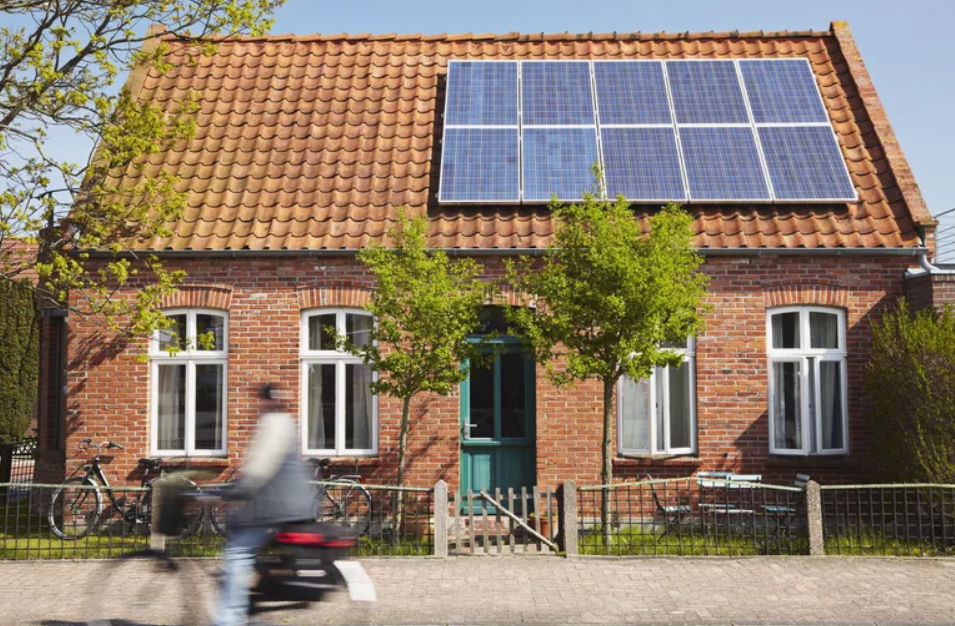
I’ve often thought we should start adding solar panels to our garden rooms, with some rooms up to 8m in length, that’s a lot of roof space that can be utilized. I hope to design and build at least one garden room this year that uses solar panels on its roof. Having just read this article on Treehugger by Sami Grover I am even more encouraged.
There is an negative argument that up until now I wasn’t too familiar with I must admit. But there is a train of thought that people with solar panels are increasing the cost of their neighbours electric. This article and the research it quotes, dispels those theories….

Ever since rooftop solar became cheap enough to start proliferating, there has been debate about fairness and equity. Specifically, some have argued that policies like net metering – where utility companies are required to pay for excess electricity that homeowners produce – are simply foisting costs on the rest of society.
But now, new research led by Joshua Pearce, a professor of materials science and engineering at Michigan Technological University, has not only discredited this assertion, but he’s actually shown that the opposite is true.1 On average, homeowners who install solar on their roofs are helping to stabilize the grid, and as such, they are actually lowering electricity costs for their neighbors. Here’s how Pearce described the value that solar brings:
“Anyone who puts up solar is being a great citizen for their neighbors and for their local utility. Customers with solar distributed generation are making it so utility companies don’t have to make as many infrastructure investments, while at the same time solar shaves down peak demands when electricity is the most expensive.”
distributed generation
Distributed generation refers to technologies that generate electricity at or near where it will be used. Distributed solar energy in the residential sector commonly includes rooftop and ground-mounted solar photovoltaic panels, which are typically connected to the local utility distribution grid.
Specifically, the study highlighted several ways that distributed solar contributes to the broader energy grid, including:
- Avoided operation and maintenance costs.
- Reduced demand for fuel.
- Reduced need for new capacity.
- Fewer plants on standby.
- Less need for power lines.
- Fewer health impacts from pollution.
And that’s apparently before even taking into account the massive inequities that the climate crisis will bring. According to Pearce and his co-author, rather than worrying about folks with solar being unfairly subsidized by those without, we should be talking about making sure that solar owners are being adequately compensated for the service they are providing to society.
The authors hope that their research can serve as a starting point for getting a more accurate picture of the societal-level economics of distributed solar, therefore allowing utility companies to better understand the value that investing in distributed solar could bring. Of course, even fully decarbonizing the electric grid is not going to get society to where it needs to go, but the study also looked at ways that solar could be combined with heat pumps to start decarbonizing home heating too. Perhaps surprisingly for those who think green tech is expensive, Pearce’s research suggested that solar-plus-heat-pumps offers a viable path to decarbonize and, ultimately, a profitable return on household investment too:
Such research is critically important if renewables are going to thrive. Not only does it help dispel some of the myths or oversimplifications about equity, but it also serves as a counterpoint to overtly political narratives that have been pushed by certain parties that benefit from polarization.
In her book, “Short Circuiting Policy,” clean energy expert Leah Stokes laid out how such concerns have been weaponized by fossil fuel interests and utility lobbyists. Not only have they been used to force rollbacks of specific net metering policies, but Stokes argued that they have also been used to drive political partisanship and division – essentially helping paint the picture of clean energy in general, and solar in particular, as being the purview of “coastal elites” and well-to-do environmentalists:
While one study on one aspect of the ongoing clean energy revolution is unlikely to reverse these forces, it does offer the hope that as costs come down – and societal benefits become clearer and harder to refute – it will become politically more feasible to enact genuinely pro-renewables policy. In the same way that solar megaprojects can help demonstrate the jobs that clean energy will bring, distributed solar may help to provide a tangible demonstration of how doing the right thing for the climate crisis can also mean doing the right thing by your neighbors.
Leave a Reply